Achieving next-gen performance on an existing platform.
In High Frequency Trading, every microsecond counts. Aviat Networks needed to push their existing FPGA-based microwave platform past what was thought possible — and do it through a software upgrade alone, without changing the installed hardware that customers had deployed worldwide.
Challenge
In the world of High Frequency Trading (HFT), the equation is simple: lowest latency end-to-end wins. With HFT networks stretching across vast spans like Chicago to New York, microwave radio is preferred for its favourable physics – easily beating fibre-optics over the same distance. Highly optimised equipment is demanded to form these links with the minimum possible added latency.
The market for this equipment is extremely competitive. HFTs are classic first adopters and want the best technology, now. Companies in this space must continue to show innovation in the race towards zero, but it becomes harder and harder to push the latency lower.
Aviat Networks is a microwave communications networking specialist providing dependable products, services, and support to customers worldwide. They specialise in high-performance systems, and nowhere is this more apparent than in High Frequency Trading.
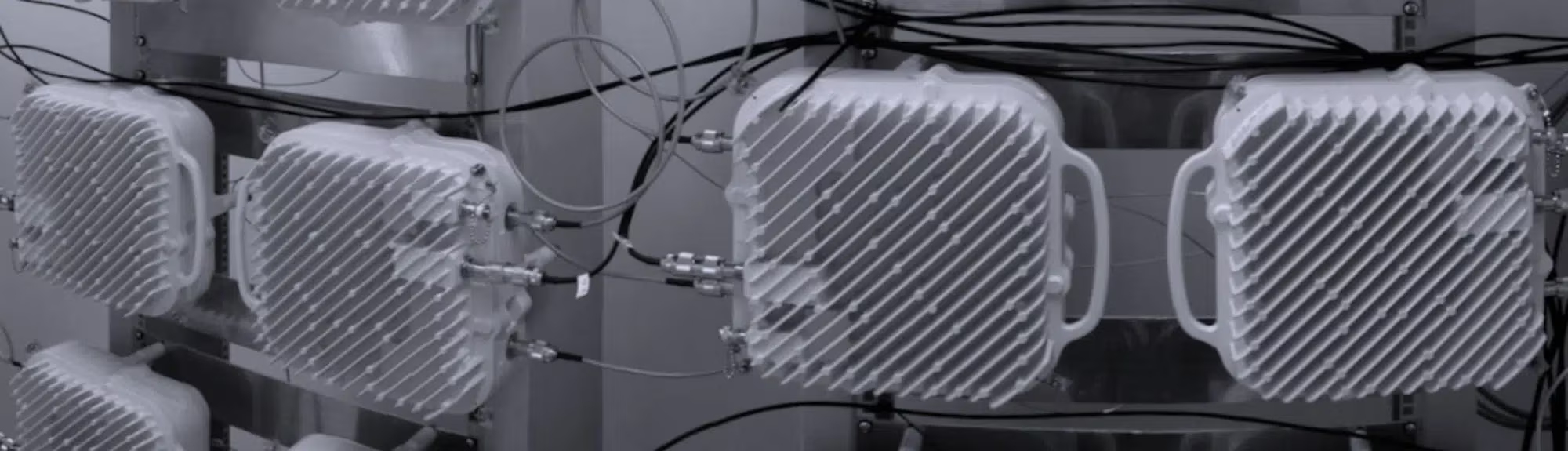
Aviat had an established, extremely capable FPGA-based platform that enabled low-latency, parallel processing for wireless data transfer. Qamcom was tasked to push the limits of this existing system – was it possible to make a state-of-the-art system with only a software upgrade?
Solution
The first thing we needed to do was put in place the right team – we needed deep expertise in communications systems, signal processing, embedded software, and, ultimately, the physical limits of systems. We also needed people who knew how to work on products that were installed all over the world and required to meet strict regulatory requirements. In New Zealand we had Dylan and Ravi providing systems, software, signal processing and FPGA expertise, and enabling direct contact with Aviat New Zealand. Our local expertise was complimented with a larger team in Gothenburg, Sweden.
Next, we analysed the system and determined its limits. Fortunately the FPGA-based platform was, indeed, highly capable, and we knew that we would be able to achieve our goal by developing and implementing algorithms specifically for this.
We then set to work, in parallel providing constant updates for Aviat and working with Aviat's customers to get the system into production networks.
"A highlight for me was that we ended up with something that we believed was truly innovative and best-in-class. We came to this point because Aviat asked a simple but challenging question: 'what are the limits?'. So, we removed prior assumptions and re-looked at communication theory and how we could re-apply this using state-of-the-art algorithms plus parallel processing to get the lowest possible latency. Super cool!"
Dylan Jorgensen, Qamcom NZ CEO and Systems Engineer
Outcome
At the end of the day we had:
- Industry leading latency via a simple firmware upgrade to installed systems.
- A 75% reduction in latency; a major step improvement in the race to zero.
- Completed on budget and, crucially, within aggressive time frames.
"Since 2012 we've been involved at the cutting-edge of low latency networks. The software and firmware upgrade from Qamcom dramatically reduced the latency of our solution. It enabled us to maintain that edge."
Matthew Hansen, VP Product Line Management, Aviat Networks
Want to learn more?